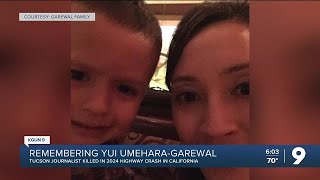
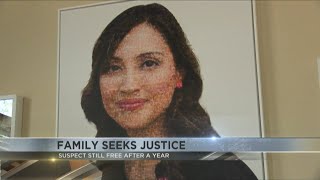
DECEMBER 26, 2024 • INTERSTATE 10, CALIFORNIA

Christian Riley Moreland
killed Yui Umehara-Garewal.

Christian Moreland got behind the wheel on just 3 hours of sleep in the last 36 hours, on one of the busiest travel days of the year. In less than an hour of driving, he fell asleep, crossed the median, and killed a wife and mother in front of her family. He lied to investigators about what happened. California law blocked the DA from charging a felony. We're working to change that.

Who He Killed

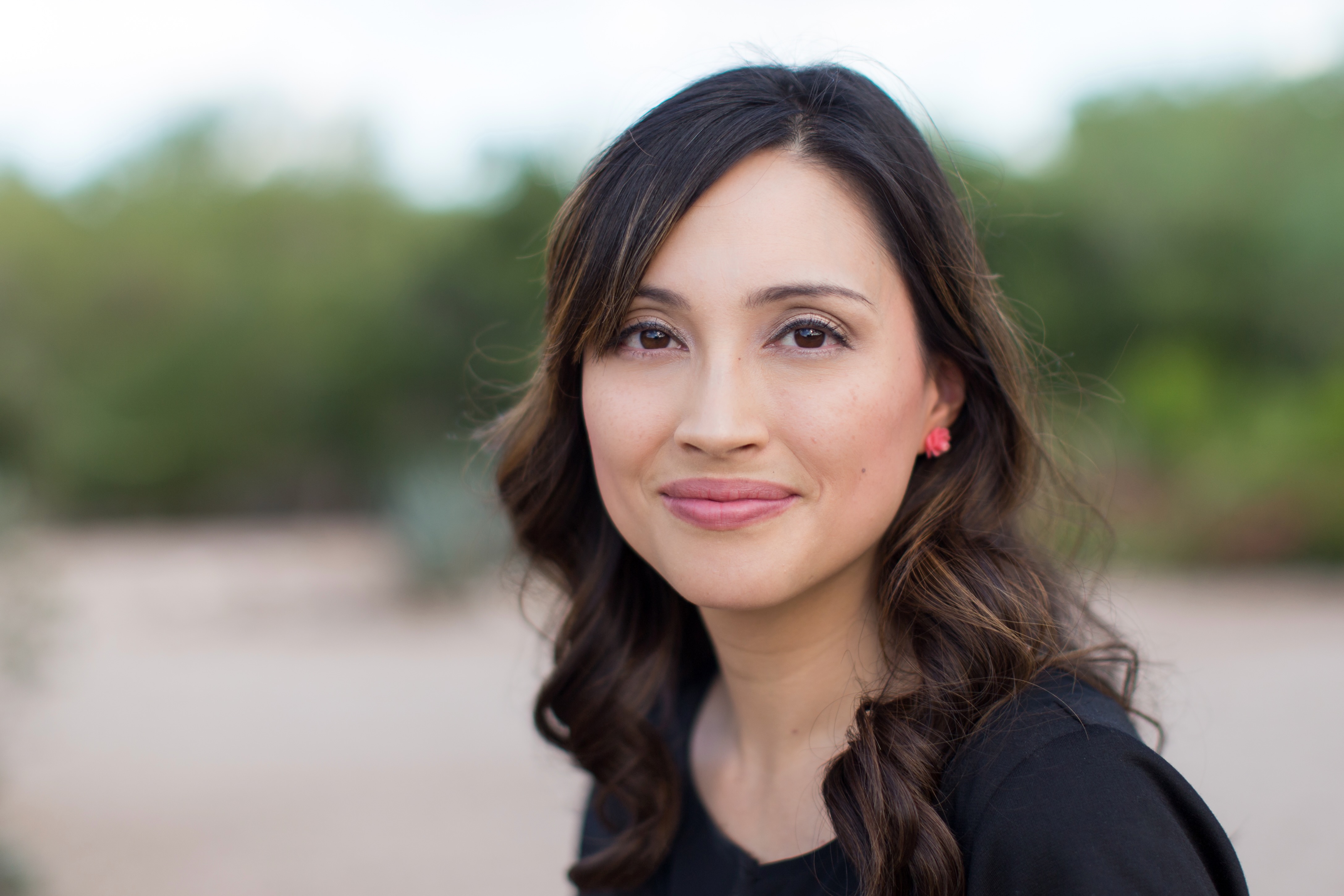
Yui Umehara-Garewal was 43 years old. She was a wife, a mother of two, a journalist, a tireless volunteer, and the heart of her community in Oro Valley, Arizona.

She spent nearly a decade as a copy editor at the Arizona Daily Star before choosing what she called "the most important job of her life" — raising her children.

Her friends describe her as someone who "made everyone around her feel so happy and loved." Her children's school principal said she "gave generously to our school by volunteering in her own children's classrooms, serving on our PTO Board, volunteering at nearly every event."

On December 26, 2024, the day after Christmas, Yui was driving her family from Tucson to California to visit friends and family. At 2:50 PM, Christian Riley Moreland crossed the median on Interstate 10 and struck their vehicle head-on. Her husband, seated in the passenger seat, heard her last words — "what the hell?" — as she saw the car coming.

Yui died instantly. Her husband and two children survived with injuries. Their lives will never be the same.

Yui Umehara-Garewal
The Victim
Yui Umehara-Garewal
July 6, 1981 – December 26, 2024
Age 43

What Christian Riley Moreland Did

On December 26, 2024, Christian Riley Moreland, then 24 years old, got behind the wheel of a vehicle near Indio, California on just 3 hours of sleep in the last 36 hours.

He was so exhausted that he fell asleep at the wheel in less than 60 minutes.

His vehicle crossed the median on Interstate 10 near Desert Center, California (about 50 miles west of Blythe) and struck the Garewals' Honda minivan. The impact killed Yui instantly and forced the vehicle into a semi.

Key Fact

At the scene, Moreland admitted to first responders and a witness that he had fallen asleep at the wheel. When asked what happened, Moreland stated plainly: "I fell asleep."

Official Documentation
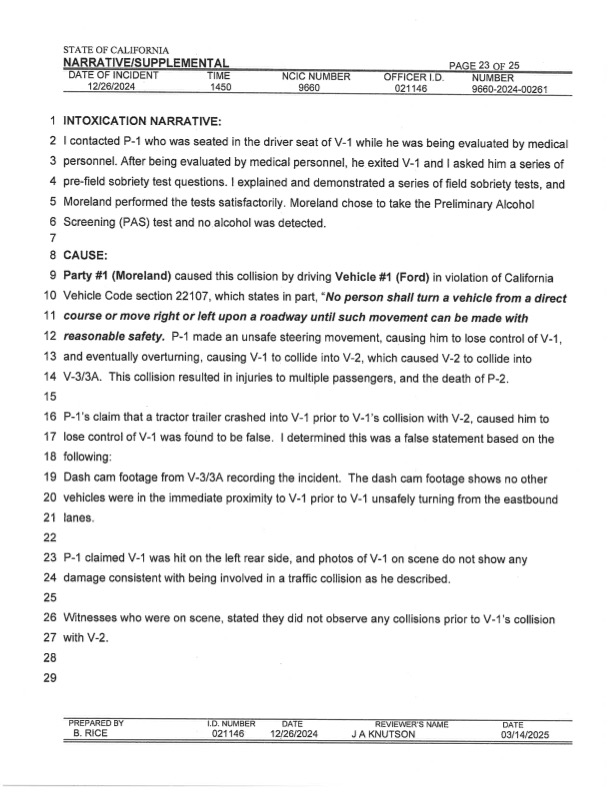
CHP Collision Report - Page 23 showing official determination that Moreland's claim was false

California Highway Patrol Collision Report, Page 23 | CHP determined Moreland's story was false

Days later, when formally interviewed by California Highway Patrol investigators, Moreland changed his story. He claimed two tractor trailers had been in front of him, that one had struck his vehicle from behind, causing him to spin out and roll. He fabricated a specific detail: that the driver of the phantom truck had walked over to him after the crash and said, "You killed that woman."

When investigators asked him why he had said he fell asleep at the scene, Moreland dismissed it as "just a bad choice of words."

CHP Determination

The California Highway Patrol formally determined Moreland's claim was false, based on three pieces of evidence:

  • Dashcam footage from the semi-truck recorded the entire incident. It showed no other vehicles were anywhere near Moreland's car before he veered off the road.
  • Physical evidence — photographs of Moreland's vehicle showed no damage consistent with being struck by a tractor trailer as he described.
  • Multiple witnesses at the scene stated they did not observe any collisions before Moreland's car crossed the median.

Moreland lied to investigators to avoid responsibility for killing a woman and injuring her family.

<60
Minutes before he fell asleep
1
Life taken
3
Others injured

Why This Is Not "Just an Accident"

Christian Moreland was charged with misdemeanor vehicular manslaughter under California Penal Code 192(c)(2), which applies when someone commits an unlawful act with "ordinary negligence."

But what Moreland did wasn't ordinary negligence. Under California law, PC 192(c)(1), felony vehicular manslaughter with gross negligence, applies when someone:

  • Acts in a reckless way that creates a high risk of death or great bodily injury
  • A reasonable person would have known that acting in that way would create such a risk
Consider the difference between drowsy driving and drunk driving:

Someone impaired by drugs or alcohol has compromised judgment: they may genuinely believe they're fine to drive. Their impairment affects their ability to assess their own impairment.

Someone who is severely sleep-deprived knows exactly how they feel. You know that feeling, when closing your eyes means instant sleep. When every part of your body is screaming for rest. Christian Moreland was in that condition when he decided to get behind the wheel. No substance impaired his judgment. He knew. He drove anyway.

The research is clear: driving severely sleep-deprived is as dangerous as driving drunk.
AAA Foundation for Traffic Safety:
  • • Missing 2-3 hours of sleep quadruples crash risk
  • • Less than 4 hours of sleep = 11.5x crash risk
  • • This is comparable to a BAC of 0.12–0.15: roughly 1.5 to 2x the legal limit for alcohol
California Office of Traffic Safety:

The state of California officially recognizes drowsy driving as a serious danger equivalent to impaired driving.

Christian Moreland was so fatigued when he got behind the wheel that he couldn't stay conscious for even an hour. The California Highway Patrol's official conclusion states the collision was caused by "a driving pattern consistent with someone falling asleep." Moreland drifted onto the shoulder, then made an aggressive steering correction that sent him across the median.

Unlike impairment from alcohol or drugs, Moreland had no substances affecting his judgment about whether to drive. He was fully aware of his extreme fatigue when he made the decision to drive. He later admitted he usually gets 6-7 hours of sleep per night... and knew he had gotten far less.

He knew he was exhausted. He knew driving in that condition was dangerous. He drove anyway.

This wasn't a question of if he would hit someone. It was a question of when.

What Should Have Happened vs. What Did

What Should Have Happened
Felony Vehicular Manslaughter
PC 192(c)(1)
  • Up to 6 years in state prison
  • Felony record
  • Active warrant pursuit
  • Meaningful accountability
What Actually Happened
Misdemeanor Vehicular Manslaughter
PC 192(c)(2)
  • Up to 1 year in county jail (often probation)
  • Misdemeanor record
  • $5,000 bail ordered / $0 posted
  • Arrested & released same day (cite-and-release)
The Riverside County DA confirmed: California law blocked a felony charge.

On March 23, 2026, Riverside County District Attorney Mike Hestrin issued a formal letter confirming that his office was "legally constrained" in the charging decision. His office conducted a careful review of the case, brought in outside experts, and concluded that California law as written "prevents prosecutorial offices" from charging cases like this as felonies.

The problem is not the DA's willingness. The problem is the law. And that is what we are working to change.

Official Correspondence

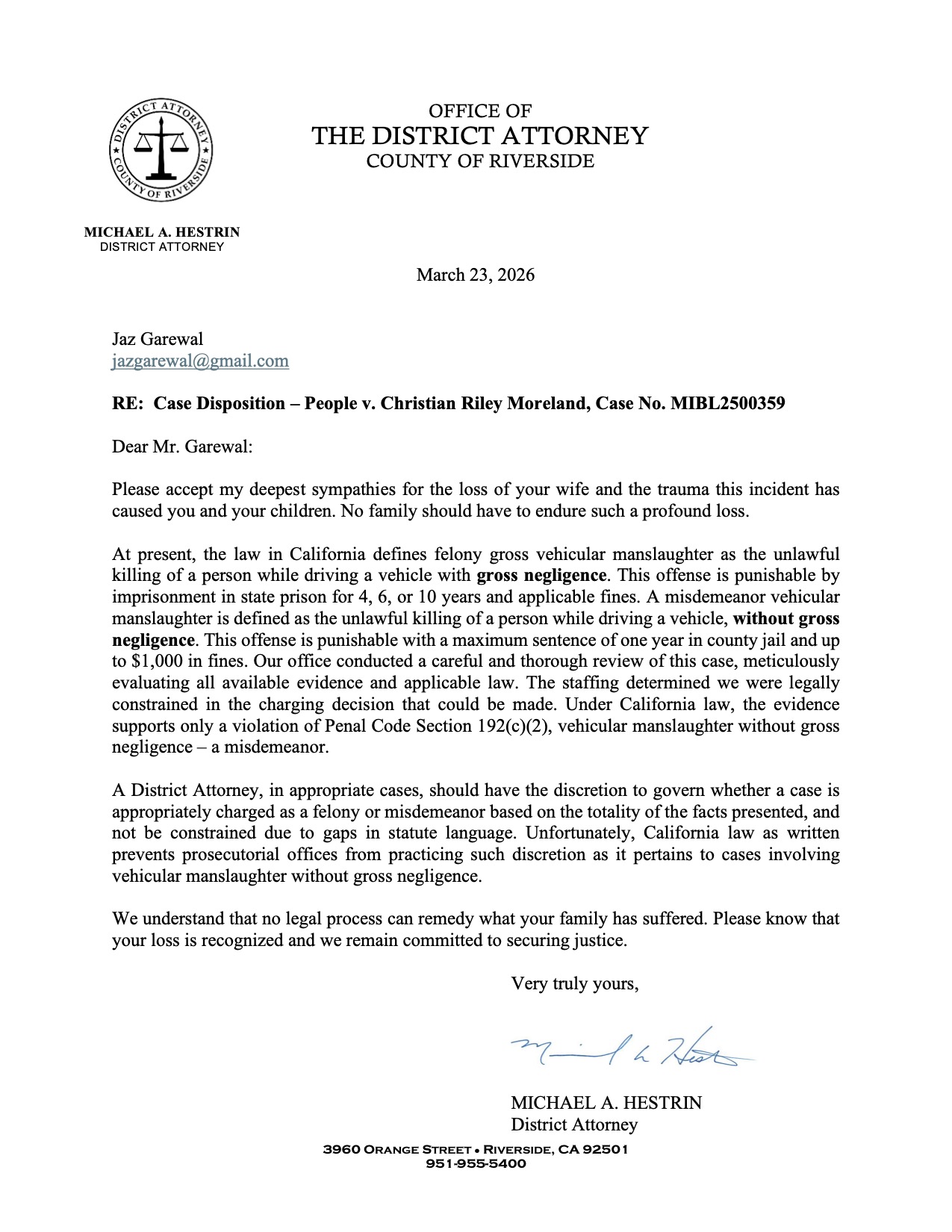
Case Disposition Letter from District Attorney Mike Hestrin

On March 23, 2026, DA Hestrin issued the following letter confirming that his office was legally constrained by gaps in California statute language:

Case Disposition Letter from Riverside County District Attorney Mike Hestrin, dated March 23, 2026, confirming that California law prevented a felony charge in the death of Yui Umehara-Garewal
Key Excerpt
"A District Attorney, in appropriate cases, should have the discretion to govern whether a case is appropriately charged as a felony or misdemeanor based on the totality of the facts presented, and not be constrained due to gaps in statute language. Unfortunately, California law as written prevents prosecutorial offices from practicing such discretion as it pertains to cases involving vehicular manslaughter without gross negligence."
Michael A. Hestrin, District Attorney, County of Riverside

What We Learned

For months after Yui was killed, the only contact our family had with the Riverside County DA's office was through victim services. What we experienced was a rotating cast of representatives, sporadic and then nonexistent communication, and basic failures that compounded our grief. One representative called looking for the husband of "Mrs. Cosswall," listed the wrong case number, and when we emailed back to say they might have the wrong person, responded that no, this was our case. When Christian Moreland was arrested and a court date was set, no one told us. We found out by searching public records ourselves, weeks later.

None of that was malicious. But victim services exists because the bar is higher for victims and families of crime victims, and even mediocre support in that context can easily feel like indifference. They induced the exact confusion, fear, and frustration that they are there to mitigate. The message we internalized was: this office does not care about Yui's case.

We were wrong about that. The smoke was in victim services, not in the DA's office as a whole.

Because of the letters that so many of you wrote. Because of the support from Yui's community, from people who never met her reaching out, from friends and family around the world refusing to let this be swept aside. DA Mike Hestrin agreed to meet with us. He told us directly that his office had received an overwhelming number of letters from Yui's community. That meeting changed everything. Hestrin explained that his office had wanted to pursue a felony charge. He had brought in two outside subject matter experts to independently review the case. Both reached the same conclusion: they could bring it as a felony, but it would not survive a challenge. California law, as written, does not provide the statutory language or precedent to establish that extreme sleep deprivation qualifies as gross negligence under PC 192(c)(1).

Then he said something that was genuinely jarring: even if Christian had been texting while driving instead of falling asleep, it would still be a misdemeanor. The first thing any of us learn behind the wheel is to keep our eyes on the road. Texting while driving is a blatant disregard for that most basic rule. When someone is texting and driving and kills another person, that is not an accident. That is gross negligence that led to manslaughter. But California law does not treat it that way.

Of course we wanted to hear that they were filing a felony. That is still what should happen. But hearing that they tried, that they brought in experts, that they were frustrated by the same gap we were, was what we had needed all along. The reality has not changed: killing someone through extreme sleep deprivation should not be a misdemeanor. But what we learned was that the people we thought were the problem were actually on our side. What we mistook for the battleground turned out to be our allies. The real fight is with the law itself.

We are grateful to DA Hestrin for taking the time to meet, for walking us through every part of their review, and for his immediate concern when he heard about our experience with victim services. He did not have to do any of that. He chose to, and it mattered.

At the end of the day, the charging outcome is not what we wanted. But knowing it was not because his office did not care or did not try is what allowed us to move forward. And for our children, Lilly and Wesley, knowing that everything that could be done was done means they will never have to wonder. That matters more than anything.
Where Things Stand Now

We did our own research as well. We reached out to the team at CalMatters.org, a nonpartisan, nonprofit journalism organization that covers California policy. Their "License to Kill" investigation is the most comprehensive look at how California handles dangerous driving cases. Their investigative data confirmed what Hestrin told us: when sleep deprivation or handheld device use was the sole factor, the charge was a misdemeanor.

And in many of those cases, the misdemeanor conviction can be kept off the driver's record entirely. That means there is nothing keeping them from keeping their license, getting insurance, and driving for a rideshare company. Think about that the next time you visit California.

The Criminal Case

  • Case Number: MIBL2500359
  • Charge: PC 192(c)(2), Misdemeanor
  • Bail: $5,000 ordered / $0 posted
  • Court: Blythe, Riverside County, Dept 260CT
  • Judge: Mickie E. Reed
  • Next Hearing: April 30, 2026, 8:30 AM
  • Status: Arrested Jan 13, 2026, released same day under PC 853.6 (cite-and-release)

About Christian Riley Moreland

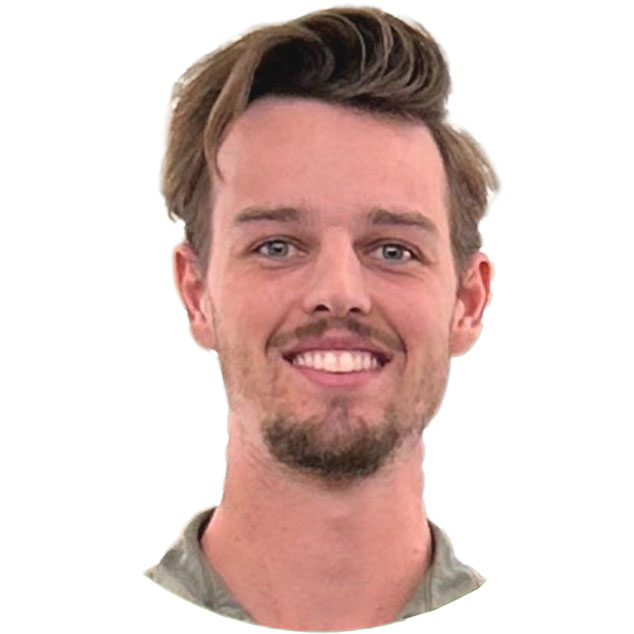
Photo
  • Age: 24 at time of crash (born 2000)
  • Education: Arizona State University (graduated 2024)
  • High School: Westmont High School, San Jose, CA
  • Last Known Location: Tempe, Arizona (no longer there)
  • Father: Paul Rodney Moreland (formerly Beaverton, OR; now Buckeye, AZ)
Christian's Social Media

Timeline

At the scene (December 26, 2024): Moreland told first responders and witnesses the truth, that he was extremely sleep-deprived and fell asleep at the wheel.

CHP Interview (days later): Moreland changed his story and lied to investigators. The CHP's investigation caught him in that lie.

December 2025: Court summons ignored. Warrant issued.

January 13, 2026: Moreland arrested and released the same day under cite-and-release (PC 853.6), without posting a dollar of his $5,000 bail. The family was not notified of the arrest, the release, or the April 30, 2026 court date. They found out weeks later by searching public records.

February 23, 2026: DA Mike Hestrin met with the family. Explained that his office had sought a felony charge, brought in two outside experts, and was blocked by current California law. Expressed immediate concern about victim services failures.

March 20, 2026: Met with Ben Edelstein, Legislative Director for Senator Bob Archuleta, at the State Capitol in Sacramento to discuss amending California law. Ben connected us with other legislators and advocates working on reckless driving reform.

March 23, 2026: DA Hestrin issued a formal case disposition letter confirming the statutory gap and calling for legislative change.

The Path Forward

The problem is not one DA's office in one county. It is California law. No county in the state has ever successfully charged a felony for vehicular manslaughter where sleep deprivation alone was the cause. The same is true for cases involving handheld device use. The statute simply does not give prosecutors the tools they need.

That is what we are working to change.

Legislative Reform

On Friday, March 20, 2026, we met in Sacramento with Ben Edelstein, Legislative Director for Senator Bob Archuleta, to discuss amending California law.

Senator Archuleta's own granddaughter, Alex Robles, was killed in a head-on collision just three days before Yui. He authored SB 907 to address dangerous driving in California. After reviewing our legislative packet, Ben and his team determined that SB 907's current focus on DUI-related offenses made it the wrong vehicle for our amendments, as expanding the scope could jeopardize an already uphill bill.

But the meeting did not end there. Ben connected us with other legislators and advocates who are working on reckless driving reform more broadly. The California State Legislature has introduced over a dozen road safety bills this session, and a bipartisan coalition is actively pushing to close the gaps that let dangerous drivers face minimal consequences. Multiple senators are working on legislation that could carry the amendments we have built, and those conversations are underway now.

The Gap

California Penal Code 192(c)(1) requires "gross negligence" for a felony charge, but no statutory language or case precedent establishes that sleep deprivation or handheld device use qualifies. Prosecutors who want to charge felonies in these cases have no legal path to do so.

The Fix

A targeted amendment that defines specific conduct, such as driving after extreme sleep deprivation or using a handheld device, as constituting gross negligence under PC 192(c)(1). This gives prosecutors the statutory authority they currently lack.

This is not just about Yui's case. We are working alongside other families who have lost loved ones to dangerous drivers and faced the same broken system. Together, we are building a coalition to ensure that California law treats killing someone through reckless, preventable behavior as what it is.

Yui was a journalist, a mother, a volunteer, and the heart of her community. Thinking about what she would actually do with this, the answer was clear. She would not stop at one case. She would try to make sure it does not happen to the next family. That is what we are doing.

News Coverage

Share This Page

Help spread awareness. Every share helps build support for legislative reform.